
Update 11/2026: The thinking in this post has since developed into Aura Boards. Current description: Aura Boards.
The method for success improves the chances of succeeding
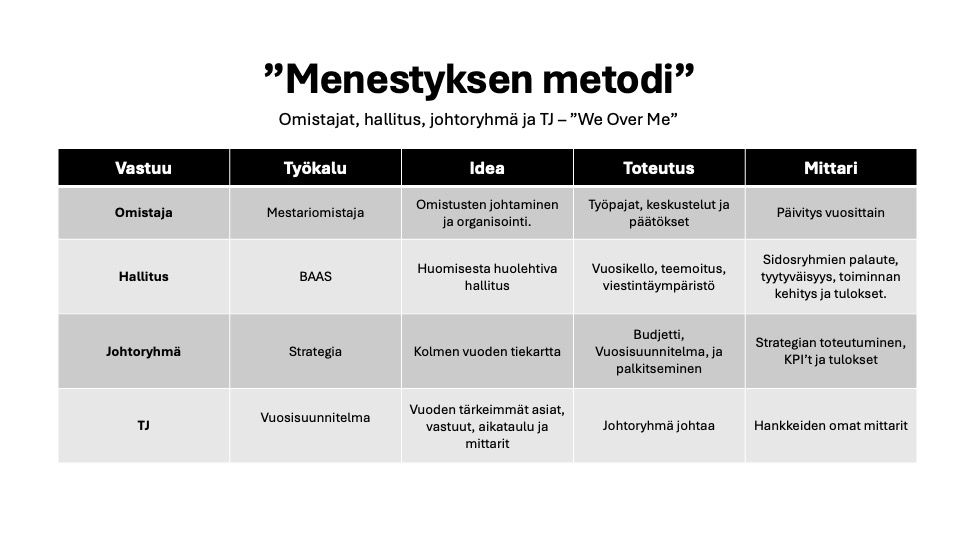
The method for success is a framework that brings together the roles of the company’s owners, board, management team and CEO, and the key practices for securing success. The idea is that sustainable, profitable business doesn’t happen by chance. It requires planning, clear strategies and continuous work. Each level has its own area of responsibility, tool, core idea, way of implementation and metrics, and together they form the foundation of systematic leadership. Below I present the role of each level in the method and compare their structure.
The owner – master owner thinking
Responsibility: The owner’s task is to give the company a clear direction through the ownership strategy. A good owner is not a passive background figure but an active direction-setter who demands development from the company. The owner has the responsibility and the opportunity to build meaningful and sustainable business.
Tool: For owners I have developed the Master Owner canvas, a systematic “ownership method” for leading ownership. Behind master owner thinking is the idea that ownership is a skill that can and should be developed as systematically as the business itself. The canvas includes, for example, a self-assessment of ownership and nine process steps with which the owner structures the different elements of ownership and draws up a development list of tasks.
Idea: The owner’s core idea is actively leading and organising the holdings. This means the owner defines what they want from the company (for example growth goals and values) and makes sure the company has a strategy and governance model aimed at it. Good ownership is a professionally led process, not just the status of owning. The owner acts as the “commissioner” of good board work and management, setting the frame for success.
Implementation: In practice owners carry out their role through workshops, discussions and decisions. The Omistajat.org network I founded is an example of a forum where owners can think about developing ownership together. Owners can hold regular strategy workshops to update the ownership strategy, discuss the company’s direction and make the decisions needed for the future. The goal is to make sure the owners’ will and vision reach the board and management as clear goals.
Metric: The owner’s contribution is measured by how systematically the ownership strategy is updated and executed. One concrete metric is updating the ownership strategy every year: are the owners’ goals reviewed and clarified at least once a year as the situation changes? Owner self-assessment is also part of the Master Owner method: the owner can test and measure their own ownership (for example with the test section of the canvas). In addition, you can follow the growth of owner value over the long term: is the company’s value growing and is it reaching the goals the owners set, which indicates successful ownership.
The board – Board as a Service (BaaS)
Responsibility: The board is responsible for making sure the company has the right strategy and that it is executed effectively, and above all for looking to the future to secure the company’s success. A traditional board that meets rarely and acts only as a statutory rubber stamp adds little value to a growth company. That’s why board work must be developed to be goal-oriented and organised, so that the board genuinely spars and challenges management forward and supports long-term value creation.
Tool: The new model is the Board as a Service (BaaS) concept, “board work as a service”. In BaaS thinking the board is seen as a service offered to owners and management that brings concrete added value, not just mandatory governance. In practice it means changing the board’s role from reactive supervisor to proactive partner. I developed the BaaS model from personal experience, frustrated with an old-fashioned board culture and wanting to bring dynamism and value to board work with the means of the digital age. A value-adding board is also a term I use: board work must be seen as part of leadership that creates value, not as a mere formality.
Idea: At the core of the board’s work is the idea of “a board that takes care of tomorrow”. In other words, a good board reserves time and attention for future opportunities and threats, not only for supervising current results. The board looks ahead and makes sure the company regularly spends time planning the future and creating the conditions for growth. It challenges management’s strategic thinking, spars new ideas and makes sure the company has a clear direction for at least three years ahead. Looking ahead also means that board meeting agendas emphasise the current situation and upcoming challenges instead of repeating yesterday’s numbers.
Implementation: For the board to work as a service and focus on the future, its work must be organised systematically. Key ways to do it are an annual calendar, themes and a modern communication environment:
- Annual calendar: Draw up an annual plan of meetings and theme days for the board. I suggest the owner invests about 8 working days in the board process (including preparation) and requires that every month there is at least “a moment for tomorrow”, a regular discussion of the future outlook. This yearly rhythm makes sure strategic issues aren’t forgotten in the daily rush.
- Themes: Each meeting or encounter can be given a theme (for example strategy, risks, people, customers), so that the board goes deep into one area important for the future each time. This helps anticipate and solve the challenges related to the themes in good time.
- Communication environment: Use a digital platform or another channel for the board’s continuous dialogue and information sharing. BAAS emphasises leading with real-time information: everyone should have a shared, up-to-date picture of the company. Digital tools (for example shared documentation and data-based reports) let the board follow the company’s key figures in real time and take part in discussion between meetings too. Most of the board’s value is in fact created between meetings, when members network, spar management informally and bring new opportunities to the table.
Metric: The board’s success can be assessed with many metrics:
- Stakeholder feedback and satisfaction: Owners, management and other key stakeholders give feedback on the board’s work. If the owners feel they get added value and management feels supported and appropriately challenged, the board has fulfilled its task. Indirectly, the trust of employees and customers in the company’s leadership also reflects the board’s ability to take care of long-term development.
- Development and results: In the end, the effectiveness of board work shows in the company’s performance. A good board promotes continuous improvement and better results, so metrics include the progress of strategic projects, the number of innovations, the success of investments and financial figures (growth, profitability, development of owner value). If the company reaches or exceeds its goals and renews itself with agility, the board has done its job right. Board evaluations (self-assessment or external) are another way to measure the board’s performance.
The management team – executing the strategy
Responsibility: The management team is responsible for drawing up and executing the strategy in line with the board’s guidelines. Based on the direction from owners and board, management usually builds, for example, a three-year business strategy (a roadmap) aimed at reaching the owners’ goals. The management team makes sure the strategy is broken down into concrete annual plans and actions, and leads the organisation in carrying them out. One hallmark of a successful company is seamless collaboration between owners, board and management “as one team”, so everyone understands the shared goals.
Tool: Strategy is the management team’s most important tool. A good strategy defines a clear direction and competitive advantage on which the work is based. I stress that the owner must make sure a strategy exists, but the board and management typically prepare it together. The strategy process produces, for example, a written strategy document or roadmap for the next ~3 years that serves as management’s compass. The management team also uses other tools to execute the strategy: annual plans, budgets and various metrics integrate with the strategy into one whole. You can also call this systemic leadership, where the owners’ strategy, business strategy, annual plan, budget and so on form one coherent platform for the company’s work.
Idea: The management team’s basic idea is to build a three-year roadmap towards the company’s vision and make sure it is shared and understood at every level of the organisation. The roadmap includes the key development projects, market and product choices and the goals with which the company intends to succeed. On top of the roadmap, management takes care of annual planning: each year gets main goals and priorities derived from the long-term strategy. That way daily work aligns with longer-term aims. The strategy must also live with the times: the management team regularly assesses execution and makes corrections when needed (for example based on market changes or lessons learned).
Implementation: The management team puts the strategy into practice through concrete plans and leadership actions:
- Budget: Each year the management team draws up a budget that allocates resources to the functions according to the strategy. The budget is a practical tool for communicating the strategy’s priorities: which growth areas get investment and where you save. In ambitious growth companies the budget is not just an extrapolation of the past but is derived from the strategic goals (I have even criticised “growth strategies” that are just a budget without real renewal).
- Annual plan: Alongside the budget comes the annual plan, which specifies each year’s most important projects, goals and schedules. It links to the board’s annual agenda: the board approves management’s annual plans and follows the progress of development projects in its meetings. In the annual plan the management team breaks the strategy into year-long pieces: what concrete things must be achieved this year for the strategy to move forward.
- Incentives and motivation: The management team also makes sure the organisation’s reward systems and incentives support the strategy. When people’s goals and rewards are tied to strategic KPIs, the whole organisation works towards the shared aims. For example, the sales team’s commission model can be tied to growth goals, or management bonuses to the success of strategic projects. That’s how the strategy lives in daily work.
- Follow-up and leadership rhythm: The management team leads the company in a systematic rhythm: weekly follow-up of operational actions and monthly review of strategic figures. Strategy execution is assessed regularly, for example in quarterly reviews. Deviations are reacted to quickly: if a project stalls or the market changes, the management team decides on corrective actions and informs the board.
Metric: The management team’s success metrics connect directly to the strategy:
- Strategy execution: The first metric is how far the planned strategy has been carried out on schedule. Have the projects in the three-year roadmap moved forward as planned? Has the organisation adopted the shared direction? The board follows this actively: is the strategy being executed and is it producing the desired effects?
- KPIs: The management team defines key performance indicators for each goal. They can be financial (for example revenue growth, profitability, cash flow vs. budget), customer-related (customer satisfaction, new customers), process-related (delivery times, quality) and people-related (employee satisfaction, retention of key people). The method for success stresses that management defines the KPIs and everyone, owners, board and management, follows the same data regardless of position. This creates transparency and a sense of a shared goal.
- End results: In the end, the management team’s work shows in the company’s results. Strategic success is measured by business development: does the company reach its strategic goals (for example a better market position, a new product launch, internationalisation) and are the key figures improving? The emergence of sustainable growth is a sign that the strategy and its execution work. Continuous learning and improvement also show in how management reacts to what the metrics say: analysing results and systematically making improvements.
The CEO – leading the annual plan
Responsibility: The CEO is responsible for the company’s operational management and for making sure the annual plan approved by the board is carried out in daily work. The CEO is the link between the board’s strategic guidelines and the organisation’s daily work. They make sure the most important goals and projects agreed for each year move forward and that resources (people, money, time) are allocated correctly. In practice the CEO leads the management team and all staff so that the actions in the annual plan are completed.
Tool: The CEO’s key tool is the annual plan. It is the yearly calendar for executing the strategy: it contains the year’s most important things, an owner for each goal, a schedule and metrics for each action. It is like a project map for the current year. I have said that business rests on the platform created by plans: the ownership strategy and business strategy set the frame, but the annual plan makes concrete what is done this year. A good annual plan includes both quantitative and qualitative goals and clear projects for reaching them.
Idea: The CEO’s idea is to make the current year’s priorities clear to the whole organisation and keep the focus on them. In communication terms this means making sure every employee knows the year’s main goals and their own role in reaching them. The CEO must define clearly which projects and tasks are most critical for the company’s success right now (for example a “Top 5” of strategic initiatives for the year) and what metrics have been set for them. The CEO must also make sure responsibilities in the organisation are clear: who leads which project, on what schedule and by when results are expected. In this sense the annual plan is also a plan for dividing responsibility. It makes visible which projects are running, who is responsible and how they connect to the company’s big picture.
Implementation: “The management team leads”: in practice the CEO delegates areas of the annual plan to members of the management team and, when needed, other key people. The CEO makes sure the management team has a clear division of the year’s goals and that every leader moves their own area forward. The CEO runs regular management team meetings (for example weekly or every two weeks) to review project status, identify obstacles and decide on the actions needed. This creates a continuous sparring and follow-up rhythm in the company. If a critical project stalls, the CEO steps in without delay: allocating more resources, changing schedules or clarifying goals.
The CEO is also the company’s figurehead and motivator: they keep communicating progress against the yearly goals to staff and celebrate milestones, which motivates the organisation. Management’s example matters. When the CEO and the management team systematically follow the metrics and talk about the goals, the culture becomes results-oriented and focused.
Metric: The CEO’s success is measured largely with the same metrics as the management team’s, but especially from the point of view of whether the annual plan’s goals are reached:
- The projects’ own metrics: Every project in the annual plan has its own KPIs or result metrics, and the CEO must make sure they are reached. For example, if the year’s goals include launching a new product by Q3, its metrics could be the launch date, X units sold and a certain level of customer satisfaction with the product. The CEO is judged by how many of the projects succeeded against their goals. Every project has clear goals, roles, a schedule and owners, and their results are measurable. The CEO is responsible for making that happen.
- Financial result and operational figures: At the end of the year it is easy to check whether the annual plan was achieved: were the budgeted numbers reached? What is the level of revenue and profit relative to the goals? Has the number of customers grown, and what about headcount and productivity? These tell you directly about the CEO’s leadership over the past year. The board and owners follow these figures closely.
- Stakeholder trust: A softer metric of the CEO’s success is whether they enjoy the trust of the board, owners and staff. If the annual plan has been carried out well, the owners see the strategy progressing as hoped, the board gets the reporting it needs and can focus on the future, and staff find their work meaningful through clear goals. The CEO has succeeded when the whole organisation pulls together towards the year’s goals.
Summary and comparison of the structure
The method for success is thus built on a clear structure in which every level has its own role, tool, idea, implementation and metrics. Common to all levels is planning and systematic work: decisions are based on information, roles are clear and every goal has measurable criteria. From the owner all the way to the CEO, the common thread is continuous improvement and looking to the future: the owner updates their strategy, the board looks to tomorrow, management builds the roadmap and the CEO ensures daily execution. At every level there is a commitment to learning and development: results are analysed and the course is corrected when needed.
The differences between the roles show in emphasis and perspective:
- The owner looks furthest towards the horizon to grow owner value. They define why the company exists and what is wanted from it (for example growth, dividends, impact), and make sure ownership is led professionally to reach that vision. The owner’s method is the Master Owner, which brings system to ownership.
- The board is the owner’s tool for creating and supervising strategy, but in the modern method above all a sparring future team. The board turns the owner’s will into strategic guidelines and makes sure the company renews itself and develops in a value-creating way. Its structure (BaaS) emphasises continuous interaction and foresight, a different approach from the traditional board.
- The management team builds the bridge between strategy and operations. It uses the business strategy as its tool and makes sure the big picture turns into budgets, plans and people doing the work. Its structure is collective: it brings the functions together so the strategy is executed across the whole organisation.
- The CEO is individually responsible for daily leadership and for carrying out the annual plan. Where the management team shares responsibility, the CEO carries overall responsibility for the operational result. Their approach is very concrete and short-term (yearly) compared with the owner’s long-term emphasis on vision, but everyone aims in the same direction.
In the end all levels share one goal: creating sustainable growth and long-term success for the company. The method for success stresses that this is achieved only if ownership, board work and management merge into one whole where everyone knows their task and uses the right tools at the right time. When the owner’s will is refined into a good strategy process, the board acts as an active partner, management leads with a plan and the CEO enables success in daily work, the result is a tightly knit system. This system can learn from its mistakes, use new opportunities and keep making better versions of what it does.
In short: The method for success is a better way to lead. It is conscious, inclusive and measurable work at every level. It offers a structure with which success can be both planned and followed. That way the company doesn’t drift but steers towards its goals through teamwork and a clear method. This is exactly the better way to succeed I keep calling for in my writing.
Read also: The perfect company, Good board work 2026 – the board as a service and an operating system for growth and Aura Boards.

Kirjoita kommentti