

Luotsi gathers my own experience to support my work: as memory, as a thinking partner and as help with preparation. Central to developing it is keeping sources, access rights and the human’s responsibility for decisions intact.
My problem is not a lack of information. My problem is that information, experience and unfinished thinking are in too many places.
In memos. In conversations. In documents. In my own head.
I have done board work for three decades, in around thirty companies and for a total of about a hundred mandate-years. Over the years I have gathered a huge number of observations about how companies grow, why they get stuck and how owners, boards and management can achieve more.
Still, I find myself returning to the same questions. What did we agree on this? Why did we end up here? Where did that good idea go? What should I do next?
I am building a solution to this. It is called Luotsi, Finnish for “pilot”.
Luotsi is my personal AI memory, my thinking partner and the interface to all my work.
Through it I want to prepare board work, develop companies, write, research, learn and put ideas into practice. The same personal way of working comes with me even as the task and the company change.
Luotsi’s task is to help me see, remember and think better. I choose the direction and I am responsible for the decisions.
I want my own experience back in use
Using AI easily starts with individual tasks. Write this. Summarise that. Find information. Make a presentation.
Useful, but my interest has moved further.
I want earlier work to improve the next piece of work. I want a good conversation to stay usable. I want the reasons for a decision to be findable a year later. I want to notice when a new observation challenges an old belief of mine.
This is where Luotsi’s value starts to grow.
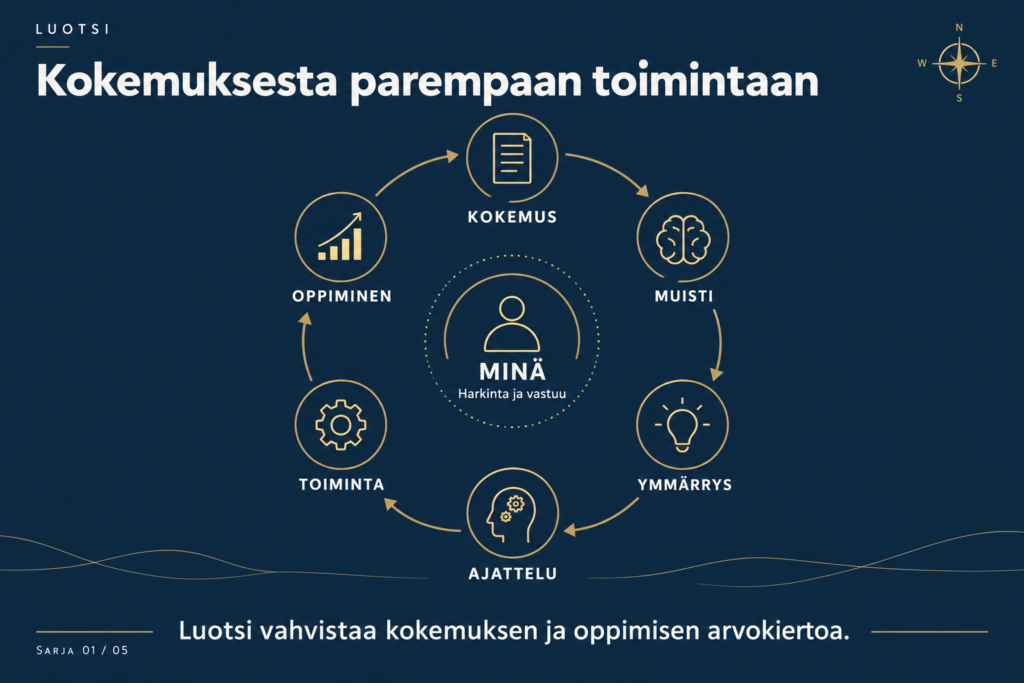
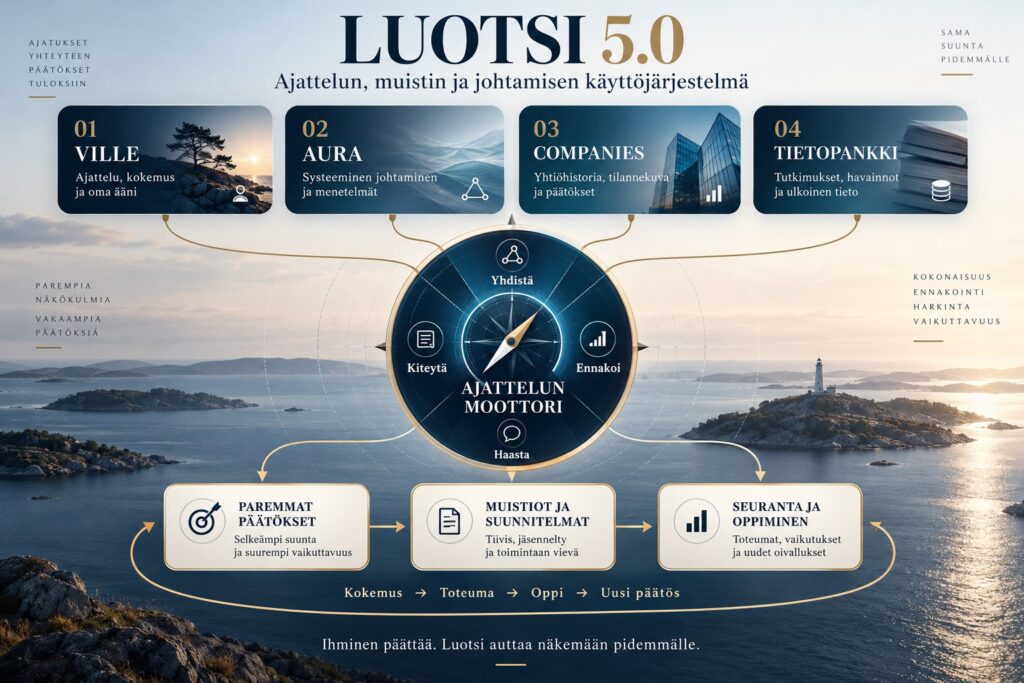
Experience becomes memory. Memory helps understanding. Understanding improves thinking. Thinking guides action. Action creates new experience and learning.
Luotsi’s most important task is to strengthen this value cycle.
Memory here doesn’t mean storing everything. It means finding what matters in the right situation, from the right source and with the right access rights.
The added value shows in the quality of the work
Saving time is a good start. For me the bigger question is how much better work I can do.
The first benefit is continuity. I don’t have to rebuild every situational picture. I can return to what we knew, what we assumed and what we decided.
The second benefit is challenging my thinking. I want Luotsi to ask where my claim comes from, what speaks against it and what I have overlooked. Fluent text doesn’t yet mean a good idea.
The third benefit is the quality of preparation. A good memo shows what matters: what the situation is, what needs a decision, what the options are and what must happen next. It makes discussion and decision-making easier.
The fourth benefit is execution. An idea needs someone to do it, a schedule and a way to check whether anything happened. Luotsi must help separate discussion, proposal, decision and completed work from one another.
The fifth benefit is learning. I can look at where my thinking was right and where it needs to change. Experience starts producing more value when you can return to it systematically.
I would rather track value through these things than through the amount of text produced: can the reasons for decisions be found, does usable preparation come more easily, do agreed things move forward, and do I notice what matters earlier?
Three bodies of information, clear boundaries
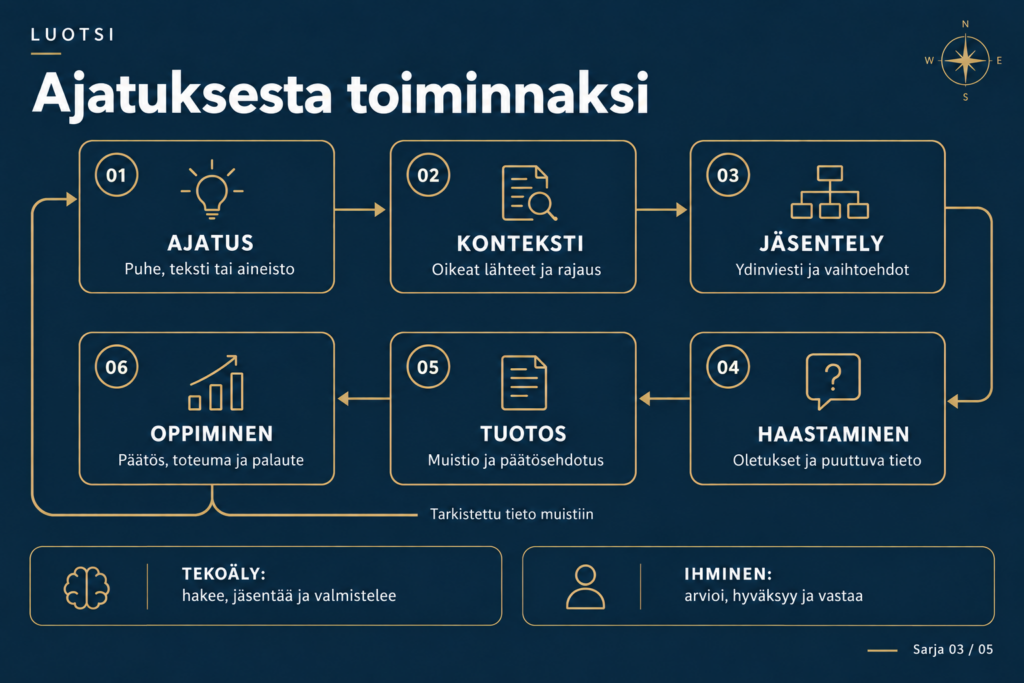
I structure Luotsi’s information in three bodies: ME, AURA and COMPANIES. They serve different purposes.
ME is my personal memory and thinking. It includes my own writing, goals, principles, questions and observations. It helps Luotsi understand what I am aiming for and how I express my thoughts.
I want to write directly. I want to see the whole and get from it to concrete choices. Luotsi must help me sharpen my own thinking and my own voice.
AURA is the library of methods I use in my work. It includes the leadership principles, question frameworks and working models approved for use. For example, a way to structure the owners’ goals, the strategy or decisions.
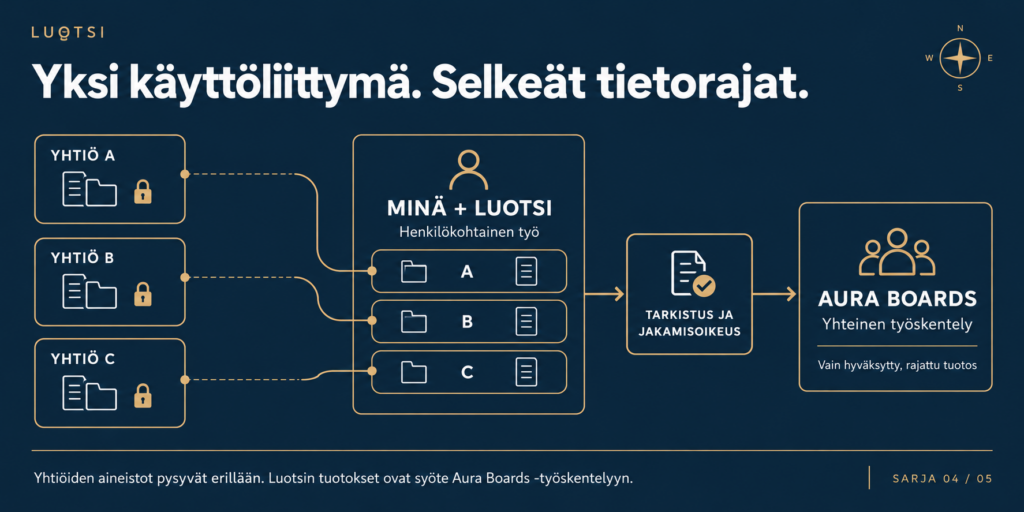
In this structure AURA means knowledge of methods. Aura Boards work is a separate whole. Luotsi does not, on this basis, include the materials of all Aura Boards clients or participants.
COMPANIES means separate, company-specific bodies of information. Every company has its own history, strategy, decisions and materials. I use them only for the task in question and within the rights I have been given.
Company A’s material is not background material for company B. The same interface doesn’t give the right to combine information.
For every essential piece of information you must be able to identify its source, date, company or other context, access right and status. Is it an observation, an interpretation, a proposal, an approved decision or a verified outcome? Corrected information and outdated versions must also be distinguishable.
Without this structure, memory easily starts to produce false certainty.
How the work moves forward with Luotsi
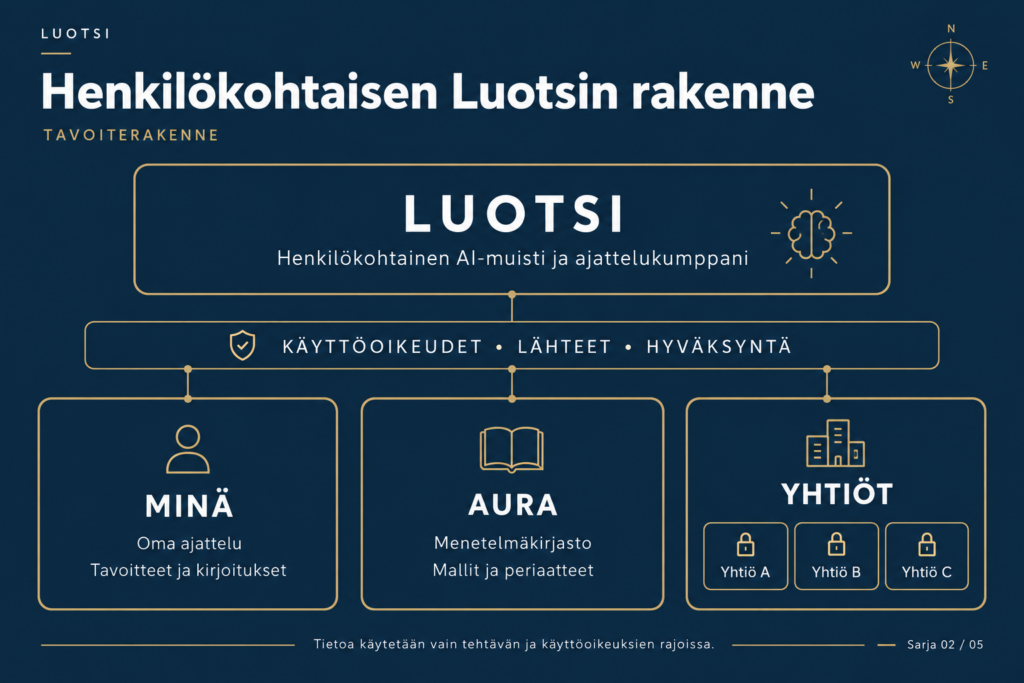
Luotsi’s operating model is built on six stages.
1. Idea. The starting point can be dictation, a question, a document or my own observation. The idea doesn’t have to be finished. Often an unfinished idea is the best starting point for discussion.
2. Context. I define the task: what am I doing, for which company or topic, and which material may be used? Luotsi fetches the necessary background from the available sources. Missing information must be identified.
3. Structuring. We bring out the core message, the question to be solved, the options and the reasoning. At the same time we separate source-based information from my own observations and from the AI’s interpretations.
4. Challenge. What are we assuming? Where is the evidence weak? Which option went unexplored? What happens if we do nothing? At this stage an idea that sounds good has to withstand scrutiny.
5. Output. The result is a memo, analysis, plan, blog post or decision proposal. I check the content and decide what is used, who it belongs to and what can be shared.
6. Learning. The approved decision, the completed work and later feedback return to the right body of information. The starting point for the next round improves.
This is the operating model I am building Luotsi towards. Not all stages happen automatically. Conversation history alone doesn’t guarantee a permanent, comprehensive or error-free memory either.
AI searches, structures and prepares. I assess, approve and take responsibility.
Two strategy days that start 12 weeks of work
A concrete example makes the operating model visible. The following description is an anonymised and simplified working example of two strategy days. It illustrates how Luotsi is used; it is not a company’s decision minutes or a report of results achieved.
On the table is renewing the company with AI. The discussion moves between AI services, customer value, security, data and leading change.
You could talk about each topic for two days. That’s why you need a structure that helps make choices.
Day one: what is worth building for the customer?
We start from the customer’s work. What problem is important enough to solve? How does the customer benefit? Does work get faster, does quality improve or is a completely new service created? How can the benefit be verified?
Then we structure the possible AI services. Do they differ from each other for the customer, or only for us? Which are repeatable services and which still experiments? What must we be able to do ourselves and where do we need a partner?
Security and data belong in the same discussion. What material does the service need? Do we have the right to use it? Where is the information processed? Who is responsible for quality and checking? What kind of error would be significant for the customer?
Luotsi’s task is to help structure the approved notes into a shared map: customer problems, service options, information needs, risks and open questions. It must make contradictions visible. If the service promise requires data that isn’t available, a better presentation won’t solve it.
Day two: what do we choose and how do we proceed?
On the second day the options are turned into bounded work.
In the example’s model we choose one primary customer problem and a service experiment related to it. We record what it must demonstrate, with what material it can be carried out and what conditions must be met before customer use.
At the same time we deal with the change: whose work changes, what skills are needed and who owns the progress? A new service needs a place in the company’s daily life.
The memo separates five things: the situational picture, the strategic choices, the decisions, the open questions and the actions. Every action gets an owner, a deadline and follow-up. An opportunity raised in discussion stays an opportunity until a decision has been made on it.
Luotsi prepares this structure. The participants check and confirm the content in the agreed way.
The next 12 weeks
After the strategy days a clear path forward is built:
- Weeks 1–2: clarify the customer problem, the starting point, the success metrics and the responsibilities. Check the access rights to the material and the conditions for processing it.
- Weeks 3–4: define the service experiment, prepare the necessary data and agree on the practices for security, quality and human review.
- Weeks 5–8: run a bounded experiment in the agreed environment. Collect feedback and compare observations with the starting point. Record the effect on people’s work.
- Weeks 9–10: assess customer value, service quality, costs and risks. Refine the service promise and operating model based on the evidence.
- Weeks 11–12: decide whether to continue, change or stop. Agree the next stage, resources and responsibilities.
Luotsi helps prepare for follow-up: what was supposed to happen, what has been confirmed as happened, and what is waiting for a decision? Updates are based on information received and checked.
This is where its value shows. Two days of discussion become a memorable whole, well-founded choices and work that can be followed. The strategy can still be returned to when daily life tries to pull attention elsewhere.
Luotsi and Aura Boards do different work
Luotsi is my personal tool and the interface to all my work. Aura Boards is the whole of shared leadership and board work.
With Luotsi I can prepare my own view, list of questions or memo. A checked output approved for sharing can then serve as input for Aura Boards work.
Luotsi helps me prepare. In Aura Boards we do shared work.
My personal observation doesn’t become a shared decision because AI writes it into a memo. A shared decision is made through that particular work and its responsibilities.
The same applies to the boundaries between companies. I can develop my own leadership thinking from experience, but company-specific information stays in its own context. Even sharing general lessons requires judgement: could a company, customer, person or confidential situation be identified from it?
A shared method can serve several companies. Company-specific material belongs to the use defined for it.
Security is part of the structure
A personal interface to all work is an ambitious goal. It requires precise boundaries.
Luotsi may use only the material allowed for the task. Company-specific boundaries must be built into how information is stored and searched and into the tools. An instruction not to mix information is not enough.
Before using confidential material, you must find out whether the chosen service and its environment are suitable for that processing. I need to know who has access to the material, how it is stored, whether it is used to train models and how it can be deleted. A target picture doesn’t yet prove these conditions are met in practice.
Not everything needs to be handed to AI either. I use the information the task needs. Storing and sharing are agreed as the situation requires.
Memory must be correctable. Wrong information is corrected, outdated information marked and unnecessary information deleted. The sources of essential claims must be findable for checking.
Action has limits too. Text in the material is not in itself permission to act. Luotsi must not infer from a document a right to send messages, share information or change systems. Permissions are defined separately, and significant outward-facing actions require my approval.
Trust comes from being able to verify the boundaries and intervene in errors.
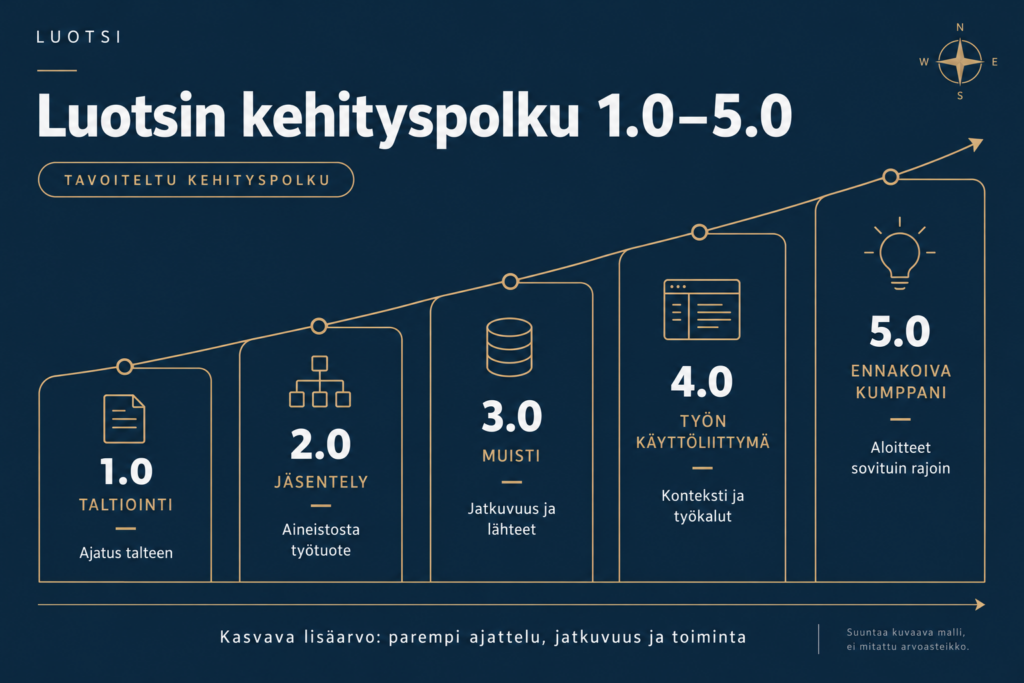
The development path 1.0–5.0
Luotsi develops along with the work. I see its development path in five versions. This is a model describing the intended growth in capability, not an announcement that all stages are ready or technically verified.
Luotsi 1.0 – capturing the idea. Speech and observations are captured in a usable form. The first value is simple: the idea isn’t lost.
Luotsi 2.0 – from material to work product. Notes become coherent memos, plans and texts. Working models reduce needless starting over.
Luotsi 3.0 – memory that returns to sources. Earlier information is found in the right context. Decisions, reasons, versions and outcomes are distinguishable. Memory can be checked and corrected.
Luotsi 4.0 – a personal interface to work. Context, methods and permitted tools support the same work. I can move from a question to preparation and from there to a finished output while keeping company-specific boundaries.
Luotsi 5.0 – an anticipating thinking partner. Luotsi could identify an unfinished matter from agreed sources, prepare an upcoming discussion or suggest a contradiction to check. Initiative works only within boundaries agreed in advance. Responsibility and decision-making power stay with me.
Move to the next stage only when you can trust the foundation of the previous one. Better automation doesn’t fix unreliable memory. Wider access to information doesn’t fix unclear access rights.
Added value grows when work continues from where it left off, thinking gets sharper and agreed things move forward. That is what I am building Luotsi towards.
I want to get more out of my experience
I have spent years gathering experience. Now I want to build a better way to use it.
I want to remember why we chose a certain direction. I want to notice when the grounds change. I want to ask better questions, prepare better and spend more time with people.
That’s why I am building Luotsi.
Luotsi helps me navigate. I am responsible for the direction.



Kirjoita kommentti