
Update 11/2026: The thinking in this post has since developed into Aura Boards. Current description: Aura Boards.
In short: Owner owns, board governs, management does strategy? That’s outdated. Systemic leadership makes owners, board and management one team.
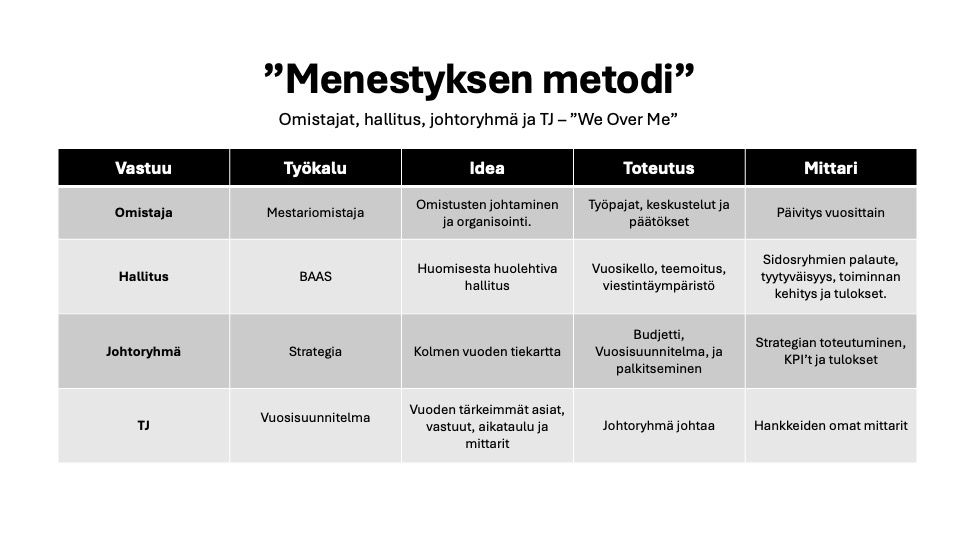
A good strategy is the shared fruit of the owners, the board and management. Ville Tolvanen wonders at organisations where “the owner owns, the board governs and management is responsible for strategy”. In his view this division of labour is “terribly old-fashioned” and makes the board almost unnecessary. The traditional siloed model has reached the end of the road. In its place rises systemic leadership, where owners, board and management work as one whole, playing together towards a shared goal. The aim is to give the company a clear direction and make sure every part supports the others in reaching results.
Ownership requires an active grip
Owning is no longer passively holding assets but actively influencing. According to Tolvanen, “ownership is a skill that can and should be developed systematically”. The modern owner doesn’t settle for watching from the sidelines but leads, develops and influences, carrying responsibility and seizing opportunities to build sustainable, profitable business. Ownership needs a method: clear principles by which the owner grows value. Tolvanen has defined four cornerstones for his ownership method: the master owner, a value-adding board, good strategy and systemic leadership, all connected. In other words, a good owner makes sure the company has a skilled board, a sharp strategy and a leadership model that supports the whole. The owner’s active role shows, for example, in building a strategy for themselves too (not only for the company) and in focusing on what matters instead of bouncing around. Ownership is not chance. It is a conscious choice, and at its best a method for succeeding.
The board as a service – added value for owners and management
Many entrepreneurs have noticed that traditional board work adds little value for a growth company. A typical board meets infrequently, and the members mostly “tell stories or, at worst, show off” about the company’s situation without bringing anything concrete. Tolvanen’s remedy is the BAAS model (Board as a Service), where the board is seen as a service to owners and management, not just a statutory obligation. In BAAS thinking the board is renewed into a genuine value creator that acts as an active partner in developing the company.
What does this mean in practice? First, the board’s role changes from reactive supervisor to proactive sparring partner. The board must not be a passive rubber stamp; it must take part in thinking ahead about strategy, investments and renewal. The focus must be “moved forward” to the future. Second, leading with real-time information becomes the basis for decisions. Everyone uses the same up-to-date data, so meetings aren’t wasted on repeating yesterday’s numbers but focus on today and tomorrow. Third, the board’s composition seeks special expertise and learning: the board is built to bring knowledge and insight the company lacks internally. The board should “teach and spar the company, not the other way round”. Members should be doers with deep expertise and time to engage, not nominal members. The fourth principle is that value is created between meetings: BAAS board work is shaped into projects and working groups that put strategy into practice, because “the real value is created between the meetings” through continuous interaction.
This kind of board work demands more time and dedication from members than the old “meeting fee culture”, but in the end the board genuinely serves the owner and management. It keeps the strategy alive in daily life and brings an outside view to decisions. Tolvanen even compares a good board to a kind of “underpriced consulting”: a way of using part-time top expertise to grow owner value. A modern board uses digital tools and data effectively; a paper-based meeting culture is doomed. “A board that draws its information from paper feels about as dynamic as a local co-operative bank in the 1980s,” Tolvanen exaggerates. The message is clear: if the board wants to stay relevant, it must renew itself with a service attitude.
Strategy, budgeting and annual planning – teamwork, not silos
Strategy work must not stay a detached annual exercise; it must be closely tied to budgeting and annual planning. In Tolvanen’s experience, “a strategy without a good annual plan is often an empty piece of paper that doesn’t change daily life at all”. A renewed strategy needs a concrete plan: how will the goals be reached in practice? Which means, projects, investments, people and actions make the strategy real? These are exactly the questions the annual plan answers. Strategy and the annual plan form a complementary package that secures results for both the company and the owners.
Who should lead annual planning? According to Tolvanen, the responsibility belongs to the company’s operational management, who are closest to daily work. The owners and the board take part, of course, but as sparring partners. It is better that “management’s own view comes to the board first (bottom-up)”, which the board can then refine together with management into “a shared tool with metrics”. Too often owners and boards get too keen on interfering with annual plans; everyone wants to see their own favourite emphasis in the plan. Tolvanen urges patience: you must agree clearly how and when owner steering comes in, so there is no ambiguity or overlapping steering. It is better for the board to support and help management when needed than to micromanage planning. That way the annual plan becomes “genuinely a roadmap and tool for management to lead the company and achieve results”. When everyone is committed to the shared plan, it becomes the company’s shared playbook: strategy turns into actions, numbers and successes that are followed together.
The management team is the company’s engine
As a company grows, its leadership model develops too. One of the most important changes is moving from leading alone to leading with a management team. Unlike in an entrepreneur-led model, the members of a working management team are independently responsible for their own areas, planning, leading and measuring them, and bring information, challenges and proposals to the shared table. A management team is only useful when every member really leads their own function and connects it to the company as a whole; otherwise it is pointless bureaucracy. Unfortunately, in many companies management team meetings focus on going over the past: reacting to what happened and updating the situation while looking in the rear-view mirror. Tolvanen calls for a change of direction: reports must be shared in advance so that the shared time can be used for anticipation, development and new decisions. A good management team meeting looks forward, at resource allocation, upcoming projects and executing the strategy, instead of getting stuck reminiscing about yesterday.
Setting up the management team as a genuinely leading team becomes topical at the latest when the company’s operations expand and become more complex. When there are several markets, products or business models, you have to delegate responsibility downwards. Tolvanen reminds us that the team leaders then form a management team that reports bottom-up and gets support for its work together. “A management team where the CEO passes updates on the company downwards is a waste of time for everyone,” Tolvanen says bluntly. In other words, if the management team only meets to hear the CEO’s monologue about the company’s situation, its existence is questionable. In an effective management team, information moves faster than decisions: material is prepared in advance, just as for the board. At best, the information and analysis produced by the management team can be used as such in the CEO’s reporting to owners and in board work. The management team is the company’s internal “board”, and developing and continuously sparring it creates value for the whole organisation.
The CEO as servant and conductor
The CEO’s role is decisive in this whole. Tolvanen, himself a CEO several times over, emphasises a change in mindset: you have to grow from “I lead” to “I serve”. A good CEO serves the owners, customers, employees and the whole company, without compromising on goals. Serving doesn’t mean pleasing; it means demanding, setting goals, following up continuously and sparring. The leader’s task is to make sure the whole 360-degree operation runs as planned. That requires both hard and soft skills: the ability to plan, organise, lead and measure everything the company does. At the same time the leader must recognise their own strengths and weaknesses. We can’t always be the expert on every topic, so “you have to know how to steer and buy things, such as information security, that you don’t have expertise in yourself”. The CEO must build a network around them where the missing expertise can be found.
A modern limited company is a network of expertise that combines top skills from different fields productively. The CEO is the conductor of this network: their job is to get the whole orchestra playing, not to play every instrument themselves. Tolvanen describes a good CEO as a leader who “can lower their own ego to serve and feed the success of others”. That doesn’t weaken leadership; on the contrary, it is a sign of strong leadership and the ability to lift the whole team to top performance. The CEO only succeeds when the whole team succeeds. Instead of personal wins, they measure success by how well the company’s people and functions shine together. In the future, as global competition intensifies and companies’ operations diverge, the ability to gather and lead a multidisciplinary group of experts will matter even more. There is growing demand for exactly these conductor’s skills in companies of every size.
A shared direction – one team
Systemic leadership means a holistic approach where ownership, governance and operations form one intact whole for growing the company’s value. Everyone acts in their own role, but the shared goal is clear and agreed together. In the spirit of Tolvanen’s BAAS thinking, owners, board and management play as one team towards a shared goal. That requires open interaction, trust and systematic collaboration across traditional organisational boundaries. In the end the whole is more than the sum of its parts: the owner creates the opportunities, the board builds tomorrow and management delivers the results. When everyone challenges themselves to develop and lead together, the result is a leadership model for the 2020s that is both analytical and agile. Put provocatively and bluntly, it is the only sustainable way to lead a company successfully in 2025 and beyond.
Read also: The method for success and Aura Boards.


Kirjoita kommentti