
In short: Board Magnet turns the board into an operating system: health check, board composition, a 1,000-day strategy and a themed annual plan.
Board Magnet turns the board into an operating system
A good board doesn’t start with a meeting invitation. It starts with the owner’s will. That’s why the most important claim of the Board Magnet picture is not visual but structural: the board is not a detached supervisory body but a service to the owners, the company and management. When the board is understood as a service, it no longer settles for confirming legality, hearing reports and moving on to the next meeting. Its task is to build tomorrow. This also fits what good governance in Finland requires: the board is responsible for the company’s administration and its proper organisation, sets strategy and evaluates its own work every year. Board Magnet tries to make this a visible, working practice.
The first step in the picture is the starting point, the health check. I consider it essential, because without a diagnosis, developing board work is too often guesswork. What condition is the company really in? Are the owners’ goals clear? Does management have the same picture as the board? What risks are we not seeing, where are decisions stalling and what does the board deal with too late? A good health check makes strategy, leadership, risks, culture, customers and the board’s added value visible. It also does something even more important: it gives the owner, board and management a shared starting line. Without it, the journey to a better board easily becomes just an exchange of impressions.
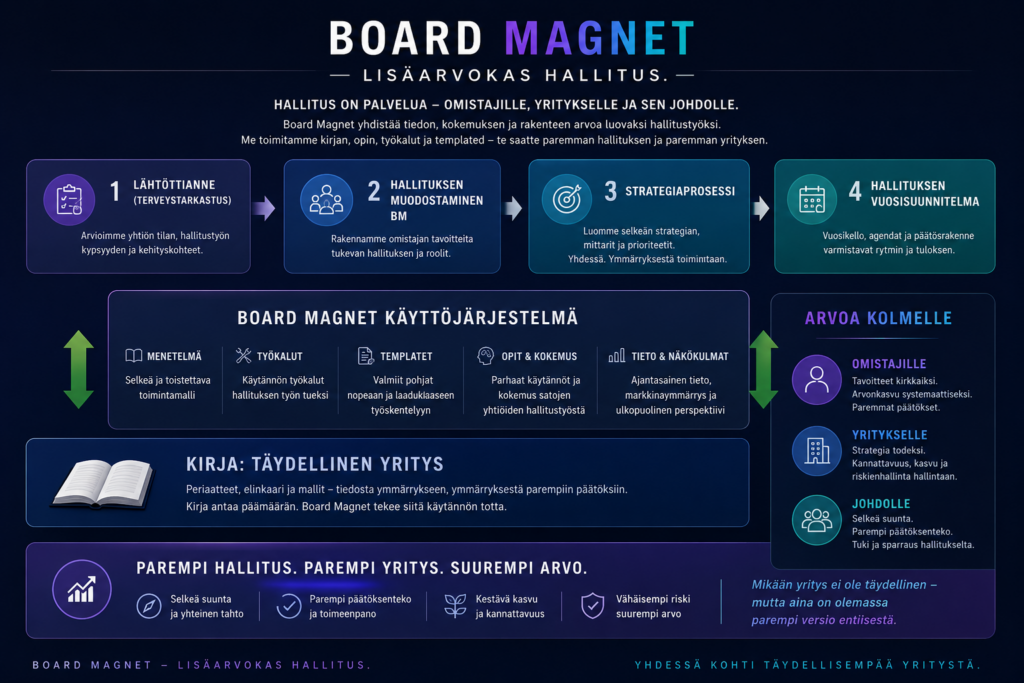
The second step is forming the board. This is where many companies fail most expensively. Boards are often built on history, representation or acquaintance, when the right question is: what value does each member bring to this company at this stage? A growing company needs different skills from a stable cash cow. An internationalising company needs different profiles from a family company going through a generational change. The composition must take into account the company’s stage, the members’ competence, time commitment, diverse expertise and whether the whole actually works as a group. From Board Magnet’s perspective this is not an HR matter but a value-creation decision. The right board speeds up growth. The wrong board slows it down without anyone noticing.
The third step is the strategy process. Here the picture hits the core of board work. The board’s job is not to browse the rear-view mirror but to look through the windscreen. That’s why Board Magnet talks about a 1,000-day playbook. The idea is good: the horizon is long enough to force structural choices but short enough to stay concrete. A good strategy process doesn’t mean one PowerPoint day a year. It means shared work where the board and management look at the market, alternative scenarios, risks, sources of growth, investment needs and different paths for owner value. Management’s job is to produce options. The board’s job is to ask the right questions, challenge, prioritise and make sure the direction is understandable for execution too.
The fourth step is the board’s annual plan. Here Board Magnet becomes especially practical. In many companies the annual calendar is still an administrative schedule: financial statements, budget, AGM and standard reviews. That’s too little if the goal is a better company. In Board Magnet’s public annual calendar model, the board year is built as a themed rhythm. Every meeting has its own main theme, goal and decision items. January opens the year, August has a strategy day, December has the board evaluation and locks the next year. Material is sent before the meeting, and the meeting focuses on decisions, not on reading material aloud. Value is created between meetings, not only in the meeting room.
The operating system in the middle of the picture explains why Board Magnet doesn’t stay just an idea. The method makes the work repeatable. The tools give the board practical instruments. Templates raise the quality level quickly. Lessons and experience save you from learning the hard way. Information and perspectives keep the board out of its own bubble. Brought down to daily life, you need at least a one-page ownership strategy, a board health check, a 1,000-day playbook, an annual board calendar, a monthly CEO review, a risk matrix, an investment analysis template and a board evaluation framework. You also need one shared data window where management, board and owners follow the same picture. Then deviations are spotted the same week, not the next quarter.
The book section of the picture matters too. The Perfect Company doesn’t mean a finished company. It means the idea that there is always a better version of the current one. It is a good principle for ownership and board work. The book gives the direction, the concepts and the ambition. Board Magnet turns that philosophy into practice. In other words, the book says where we are heading. The board, tools, annual calendar and metrics say how we get there. I think this is the picture’s strong insight: philosophy without structure stays talk, but structure without philosophy stays administration. Board Magnet tries to combine the two.
The right edge of the picture talks about value for three. For the owner, Board Magnet promises clearer goals, more systematic value growth and better decisions. For the company, it promises that strategy comes true: growth, profitability, investment and more controlled risk-taking. For management, it promises a clearer direction and genuinely useful sparring from the board. The promise is credible on one condition only: these benefits must be tied to measurable management. That’s why a good Board Magnet delivery needs, at a minimum, metrics for satisfaction with the board process, progress of strategic projects, profitability, cash flow, risk visibility and the development of owner value. Otherwise talk of added value easily stays a mood.
That’s why I like this picture. It doesn’t sell a single meeting, a board seat or an advisory service. It sells the idea of a better leadership structure. First you understand the starting point. Then you build the right team. After that you make the strategy shared and manageable. Finally you build an annual plan that puts the rhythm, agendas, decisions and responsibilities into practice. Done well, the result is exactly what the picture promises: a better board, a better company and greater value. Not because the board exists, but because it does its work visibly, with rhythm and with purpose.
Deliverables, timelines and metrics
The table below combines the stages of the picture, my public Board Magnet/BAAS publications and Finnish governance benchmarks into one recommended implementation package.
| Deliverable | What it contains | Recommended timeline | Main responsibility | Example KPIs |
| Board health check | Online survey, interviews, joint review and written conclusion; assesses clarity of strategy, roles, quality of information, risk visibility and the board’s added value. | 2–4 weeks | Chair + external facilitator; CEO involved | Response rate, baseline score, 3–5 jointly agreed improvement areas |
| Board composition plan | Skills matrix, roles, time commitment, independence/diversity check, candidate profiles and onboarding framework. | 3–6 weeks | Owner + nomination committee/chair | Identified skills gaps filled, onboarding ready, attendance rate |
| Strategy process and 1,000-day playbook | Scenarios, sources of growth, investment and divestment options, measurable goals, development projects and a KPI tree. | 6–10 weeks | Board + CEO + management team + facilitator | Share of projects on track, forecast accuracy, revenue, EBITDA and cash flow targets |
| Annual board calendar and action plan | 11 themed meetings, kick-off, strategy day, wrap-up, decision items, responsibilities, material ready 5 working days in advance. | 2–3 weeks + annual update | Chair + CEO | Materials on time, action closure %, time spent on strategic discussion, per-meeting usefulness score |
| Shared KPI dashboard and AI situation room | 52/12/365 rhythm, weekly message, monthly review, real-time handling of deviations, AI support for health checks and preparing proposals. | 4–8 weeks | CEO + CFO/controller + chair | Timeliness of KPI data, response time to deviations, forecast accuracy, risk register updates |
| Board evaluation and annual update | Year-end evaluation: structure, process, added value and readiness; next year’s annual calendar and possible composition changes. | 2–3 weeks a year | Chair + whole board + owner | Satisfaction with the board process, share of change proposals implemented, next year locked in time |
Sources
- Good board work 2026 – the board as a service and an operating system for growth
- Board Magnet annual calendar 2027 (PDF, in Finnish)
- Finnish Corporate Governance Code 2025 (PDF, in Finnish)
- Finnish Limited Liability Companies Act (PDF, in Finnish)
- Boardman evaluations (in Finnish)
- The perfect company
- BAAS 2026 (in Finnish)
- A better board for the company (in Finnish)


Kirjoita kommentti