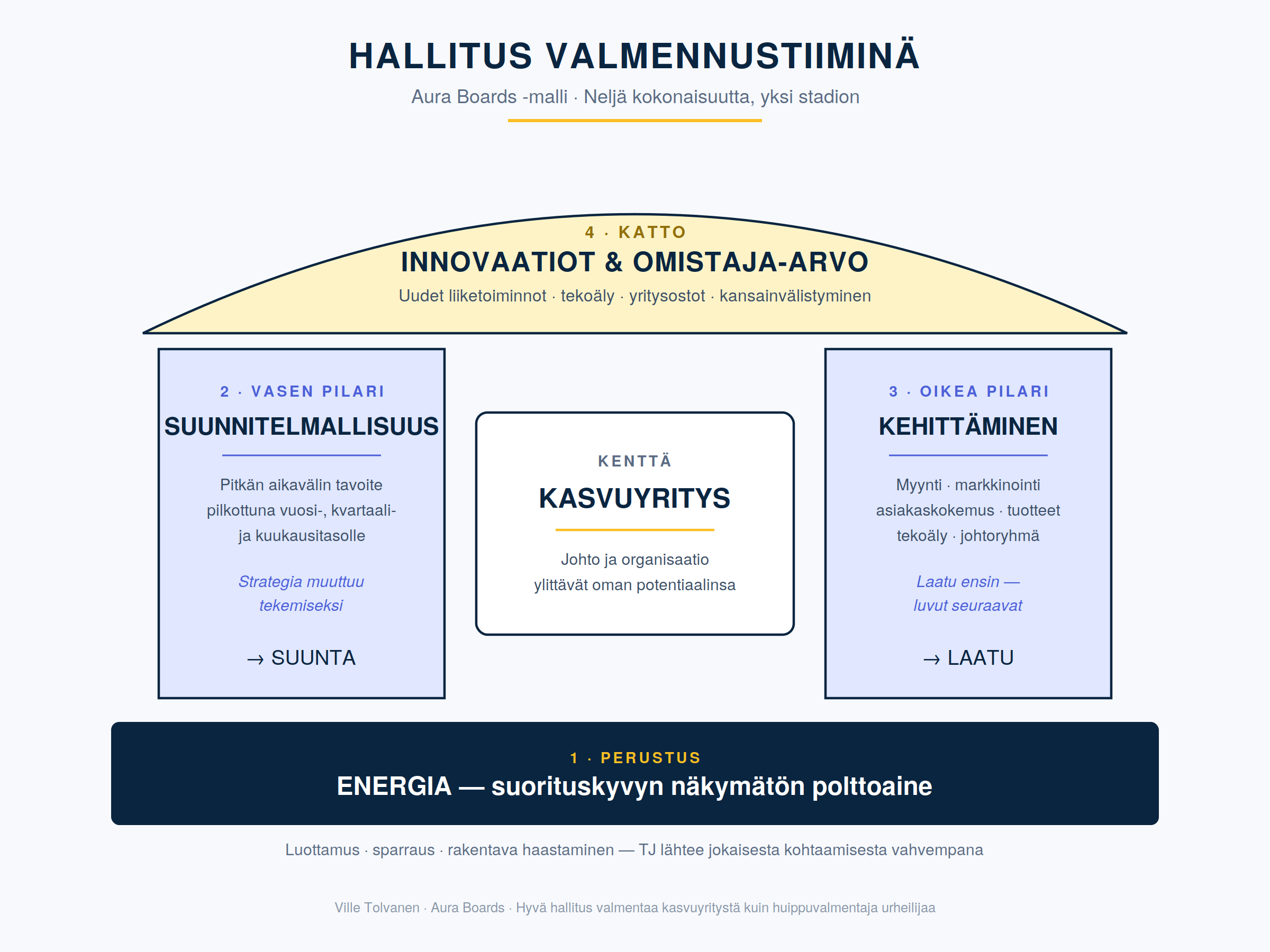

A good board helps a growth company improve its performance. The coaching metaphor highlights energy, planning, development and the next growth leap.
Many people think the board’s most important task is to supervise management.
Wrong. At least in a growth company.
I have sat on dozens of boards. The worst were audit committees: go through the numbers, nod, go home. The company didn’t develop before the meeting or after it. The best boards work like a top coach. They build energy, create structure, develop performance and help find the next growth leap.
A top athlete doesn’t succeed on talent alone. They need a team around them that supports, challenges and develops them every day. A growth company needs exactly the same.
I think of the board’s task through four areas.
1. Energy – the invisible fuel of performance
Everything starts with energy.
The board’s most important task is not to fill the agenda but to increase management’s energy. The test is simple: is the CEO braver, wiser and stronger after the meeting than before it? If not, the board failed, however tidy the minutes.
Energy comes from trust, interest, constructive challenge and reinforcing success. And it is created between meetings: calls, sparring, networks. Management knowing it is not alone.
When energy grows, decisions speed up and the organisation’s self-confidence strengthens.
2. Planning – a training programme towards the goal
A top athlete doesn’t train at random. Every session has its place in the whole.
The same goes for a company.
The board’s task is to build a clear long-term goal and break it down to yearly, quarterly and monthly levels. Then the whole organisation knows what matters right now. Strategy turns into action.
Just as important: the board stops the company from chasing every shiny opportunity. Persistence comes from short-term decisions serving a shared goal. Success is a method, not chance.
3. Development – quality first, the numbers follow
In sport the focus is on technique, training and recovery. Results follow development.
Companies often do the opposite. The conversation revolves around revenue, EBITDA and cash flow. But these are consequences of how well the company works.
That’s why the board should spend a significant part of its time on the qualitative development of the business:
- How does sales work?
- How does marketing create demand?
- How is the customer experience developing?
- How are products developed?
- How is AI being used?
- How does the management team work together?
When processes, skills and operating models improve, the numbers are exceeded as a natural consequence.
A good board doesn’t manage numbers. It helps build a better company.
4. Innovation – the next growth leap
Developing the everyday keeps a company competitive. But owner value usually grows when the company does something completely new.
That’s why the board’s highest task is to lift its eyes above the everyday:
- What new businesses can we build?
- Could AI change the whole operating model?
- Is an acquisition the right way to accelerate growth?
- Should we invest in new technology?
- Would internationalisation open a whole new market?
These ideas aren’t born in the middle of operational routine. They are born in conversations between the board and the owners, where people dare to think further than the next quarter.
The board is part of the coaching team
When the four areas are in balance, the board turns from a supervisory body into a builder of performance:
- Energy gives the strength to act.
- Planning gives the direction.
- Development raises the quality of the work every day.
- Innovation builds the next growth phase and grows owner value.
A top athlete doesn’t win because the coach runs on the track for them. They win because the team around them makes them a little better every day.
That is what the board of a modern growth company looks like. Its job is not to control the company, but to help the company exceed its own potential.
What kind of coaching team does your company’s board form?

Kirjoita kommentti