
I have been using AI for a long time to support my thinking, writing and work. I have often said that, for me, AI is above all a second half of my brain. I can talk to it, explore unfinished ideas and build things I could not complete as quickly on my own.
This week, however, something happened that made me rethink the whole thing.
We have been building my personal AI working environment, Luotsi, for some time. It now connects calendars, emails, LinkedIn post data and documents collected in Google Drive. The same environment provides access to the materials for my book projects, Aura Boards’ management philosophy and methods, and a large collection of earlier writings and conversations.
We also have external web search, AI reasoning and the ability to assess the quality of our work regularly.
That changes quite a lot.
Previously, I discussed things with AI that I already knew something about. Now, at our best, we can discuss things we have been building knowledge about together for a long time.
The difference is significant.
Memory is a good start. But what do we do with it?
Many people use AI to produce text. Write an email, summarise a report, create a presentation or post on LinkedIn.
That is useful. But it is also a rather modest way of thinking about what the technology makes possible.
I am more interested in what happens before we write the text, and what happens afterwards.
Where does a good idea come from? How should we challenge it? What do we know from earlier experience? Has someone else researched the same question? How does an idea change when we discuss it with others?
And most of all: what do we learn from all this?
I have spent much of my career as an entrepreneur, consultant, investor and board chair. Along the way, I have accumulated experiences, successes, failures and perspectives.
Most of that experience, however, has been scattered across blogs, presentations, emails, memos and, above all, my own head.
Now we have an opportunity to bring it all together.
Not because the machine knows everything, but because it can help find the right information, identify what is missing and challenge my thinking.
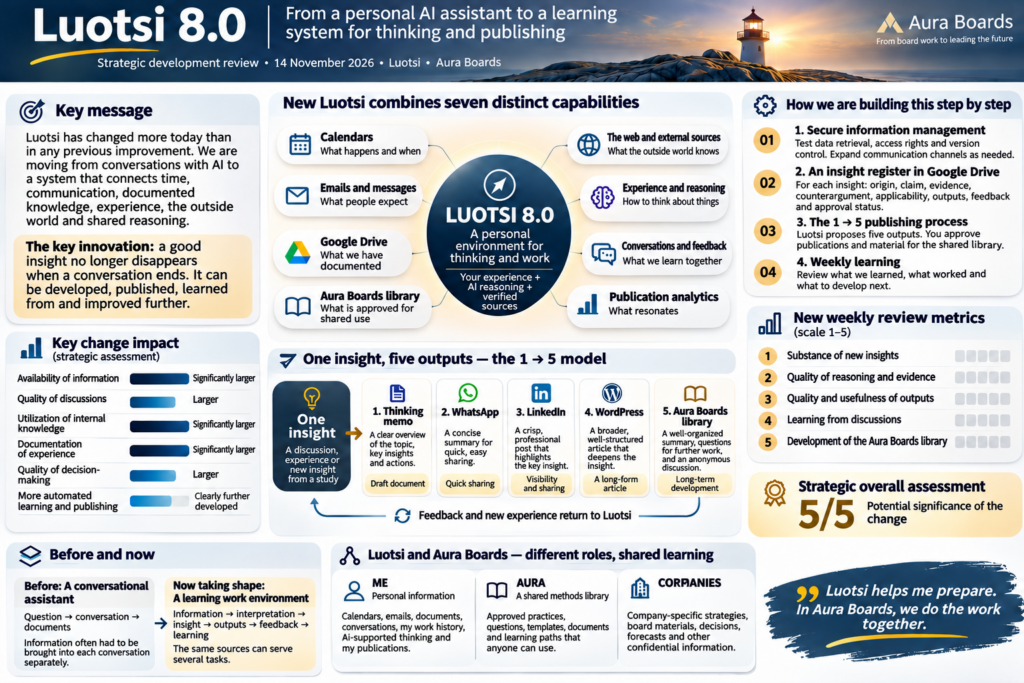
One insight, five outputs
We decided to try a new approach.
When an interesting observation or idea emerges, we begin developing it together. At its best, one insight can lead to five different outputs.
1. A thinking memo. We put the idea into words. What exactly are we claiming? What is it based on? What is new about it? What could prove it wrong?
2. A WhatsApp message. We test the idea in a smaller circle. We do not share a finished truth. We ask how the idea looks in light of other people’s experience.
3. A LinkedIn post. We open the discussion to a wider audience. The most interesting responses are different experiences, counterarguments and questions, rather than likes.
4. A blog post. We explore the idea in greater depth, connecting it with experience, research and earlier thinking. The post remains available to find and reassess later.
5. A lesson for the Aura Boards library. If the idea is broadly applicable, useful and sufficiently well supported, it can, after approval, become a shared question, principle, working model or tool.
The fifth output is particularly interesting to me.
At that point, personal experience can become something that other people and companies can use.
Five publications do not yet mean learning
This is where AI challenged my original plan.
Producing five outputs from the same idea is, in the end, simply repackaging content. Many tools can already do that.
Learning only begins when something comes back from those outputs.
A WhatsApp discussion may reveal that I have not understood the issue properly. Someone on LinkedIn may offer a better argument. Research may produce contradictory findings. Practical board work may show that an attractive idea does not actually work.
Then the original idea has to change.
And sometimes it has to be abandoned.
For me, this is the most important feature of the whole approach.
We are building a cycle of thinking and learning, rather than a production line for five publications.
Most ideas should not even reach all five stages. If an idea does not stand up to discussion in a small group, it is good that it stops there.
Quality leads. Quantity follows.
What if AI always agrees?
This is another important question.
When AI knows my writing, experience and ways of thinking, it can become an excellent conversation partner. But it can also become an echo chamber.
It would be very pleasant to talk to a partner that always understands me and thinks my ideas are excellent.
I would probably not learn very much from it.
That is why Luotsi also needs to learn to disagree.
Is this really a new idea, or have I been writing about the same thing for ten years? What would someone who disagrees with me say? What does the research show? Which assumptions are weak?
AI should help me draw better conclusions, rather than reinforce all my existing beliefs.
I consider this one of the most important requirements for working well with AI.
Information needs boundaries too
When AI gains access to emails, documents and other work, responsibility grows as well.
My personal information, confidential materials belonging to different companies and Aura Boards’ shared methods library are different things.
They must remain different things.
Information obtained on one board cannot simply be used in another company. Nor does an individual email become public material just because AI can read it.
Shared learning can draw on approved, anonymised observations and general principles. Confidentiality must be checked before any external discussion, rather than only when writing the final publication.
Decisions also remain with people.
The machine can search, connect, compare and suggest. People must understand, assess and approve.
Could experience become a shared asset?
This also connects with the bigger idea behind Aura Boards.
We want to develop ownership, board work and management so that companies can anticipate more effectively, make better decisions and keep learning.
For me, Luotsi is a personal working environment. Aura Boards is a community where we can develop management methods together.
Luotsi helps me prepare. In Aura Boards, we do the work together.
If we can turn experience into broadly useful methods and test them in practice, one company’s success or failure can generate useful learning for others too.
Then knowledge does not remain only in documents.
It becomes action.
And, at its best, better management.
Time to try it
This post is the first experiment with the new approach.
The idea emerged from a conversation. We then wrote a memo that also challenged the original model. In particular, AI raised the need to demonstrate learning, protect confidential information, avoid an echo chamber and stop weak ideas early.
Those observations changed my original thinking even before the first publication.
Now I am interested in what others think.
The aim is not to produce as much content as possible. It is to make better use of experience, think more clearly and learn faster.
For me, AI’s greatest opportunity is ultimately not that people can do more.
It is that people can learn more from what they do.
One insight. Five possible outputs. Continuous learning.
What do you think? Could an approach like this help you in your work too?
V.
Kirjoita kommentti